


Call for Abstracts (DH2026)
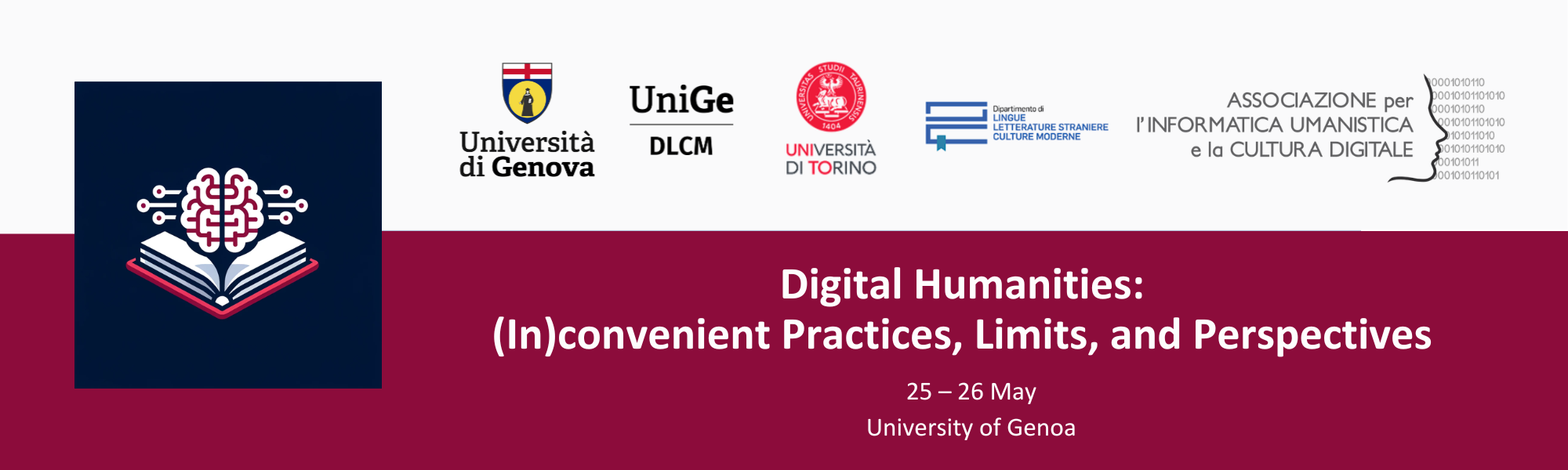
Digital Humanities:
(In)convenient Practices, Limits, and Perspectives
25 – 26 May
University of Genoa
The PhD Program in Digital Humanities of the Universities of Genoa and Turin is pleased to renew its invitation to doctoral students to participate in the third edition of its PhD Symposium, under the patronage of Associazione Italiana per l’Informatica e la Cultura Digitale (AIUCD), to be held at the University of Genoa on 25 and 26 May 2026.
The programme includes four thematic panels that reflect the doctoral curricula, described below. There will also be keynote speakers of national and international renown.
The Call for Abstracts is available at this link.
All proposals must be sent in .docx and .pdf format to the following email address: giornatadh@unige.it.
Deadline for submitting long abstracts (1000–1500 words): 18 February 2026 2 March 2026, 1 P.M. CET.
The conference will be held in person. Participation in the conference is free of charge, subject to registration via the form on the Useful Links page. Coffee breaks and lunch breaks will be provided on both days.
Selected authors will be invited to present their contributions in thematic sessions. The maximum duration for each presentation will be 15 minutes. Each block of thematic presentations will be followed by a Q&A session.
Contributions will be reviewed and, if accepted by the scientific committee, presented during the conference and subsequently published in a volume edited by Genova University Press.
Art, performing arts and heritage
- Immersive Experiences and Virtual Museums;
- Digital technologies for archiving and documentary heritage;
- Digitisation and analysis of artistic and architectural heritage;
- Performing and multimedia arts;
Linguistics, translation and language technologies
- Technological impact on translator's training;
- Linguistic variation;
- Between past and present for an analysis of the territory;
- Hybrid workflows MT+LLM;
- Troubleshooting in research processes.
Literary and cultural research
- Computational analysis and interpretative models;
- Hybrid narratives, between literature, media and interactivity;
- Bias in corpora and digital editions;
- Teaching literature in a digital environment;
- Bias in algorithms and computational tools;
Teaching technologies and new learning environments
- Teaching and Artificial Intelligence;
- Digital Skills and Active Citizenship;
- ‘A Game-Changing Factor’: gaming as an educational tool;
- Digit‘ALL’ inclusive: digital technologies for inclusive teaching;
- Digital Subjects and Cultures